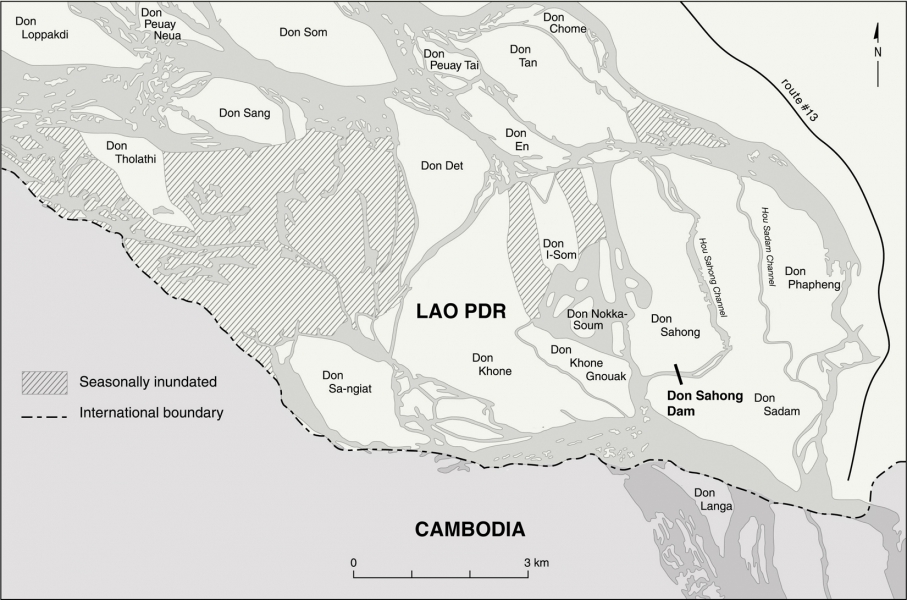
Don Sahong is a place, an island in the Mekong River. It is a case study of the hydropower debates that have continued into the 2020’s. At Siphandon, just north of the Laos-Cambodia border, the Mekong braids out into a dozen channels and drops nearly 30 meters over a series of waterfalls.
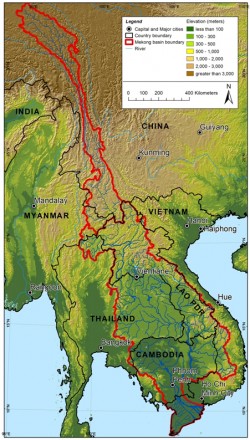
The Mekong River, or Mae Nam Khong (literally – mother water) gathers water on the Tibetan plateau and flows 430 km to the South China Sea through China, Burma, Thailand, Laos, Cambodia and Vietnam.
The Mekong is a major transportation route for much of its length. It is livelihood for 60 million humans and life for over 1000 species of fish. A few hundred wild Asian elephants remain, a few dozen freshwater dolphins, and a 450 kg freshwater ray. It is the most productive freshwater fishery in the world. And it depends on seasonal migration.
The falls at Siphandon are a natural barrier for much of the year. One channel allowed fish to pass at all water levels – the channel alongside Don Sahong island. A hydroelectric dam was built there.
Map: International Rivers
Map: mekongriver.info
The Mekong is a complex interconnected biological system of main stem and tributaries, sediment and nutrient flow, fish and other species diversity. Overfishing, scores of dams on tributaries, agriculture, industry, deforestation, and more recently mining for gold and rare earth minerals have already had heavy impact.
There are many completed hydropower projects on the upper Mekong main stem in China. Though no longer a ‘wild’ river, the main stem of the lower Mekong remained un-dammed until the late 2010’s.
Lower Mekong governments often argue that harvesting the wealth of the river is necessary to improve national income, infrastructure, and quality of life.
For example, for decades Laos was one of the poorest countries on the planet. Laos has real needs. It continues to be the most bombed country in history. From 1964-73, Laos received the equivalent of a full B-52 bomber every eight minutes for nine years. Wanting a better future is justified.
One River Project
The One River Project was started in 2013 by a teacher and ecologist. They saw parallels and connections between Columbia River history in the Western United States and Canada, and current Mekong issues. With our Mekong partners, our goal is to support relationships and exchange between river people, organizations, citizens, and students.
Mekong basin governments face complicated issues. Globalized economy and nationalized control of planning and resources vie with local and regional desire for control of food, energy, and livelihood security. On the Columbia River, those same pressures have been playing out for decades, and they continue in debates about the fishery, climate, power generation, water rights, and now data centers and the green energy transition. Despite physical and cultural distance, the rivers are linked by history, the global economy, and similarities in the lives and lifeways of river people.
The One River Project is renovating our website. Updated pages will be posted and new content added about history, current issues, and connections between the stories of two great world rivers.