Celilo to Pushpum

Welcome to the Columbia River


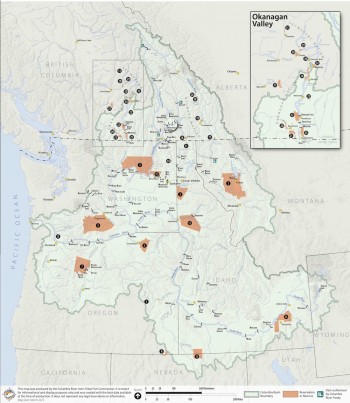
The Columbia River starts in Canada’s British Columbia and gathers water from tributaries in the U.S. states of Idaho, Oregon, Utah, Washington, Wyoming, and numerous sovereign tribal nations. Less than two months after Columbus’ return to Europe in 1493, The Doctrine Of Discovery was declared to justify and govern colonization. Centuries later, U.S. President Thomas Jefferson envisioned an irrigated, agriculture-based Columbia River empire. He used similar language, and in 1804 he sent the Corps of Discovery Expedition to establish immigration routes from the Mississippi River basin to the Pacific Ocean.
 

But people had been living in the Columbia River basin for at least 12,000 years. They already had complex societies, and their trade and information networks spanned the continent. The fisheries at Celilo Falls, Kettle Falls, and elsewhere in the Columbia River basin were village sites and seasonal trading hubs. Native Tribes have stories of the Corps of Discovery arriving hungry and lacking basic knowledge. Native people say that Jefferson’s irrigation plans showed that the existing type of agriculture – practiced for thousdands of years – was impossible for immigrants to understand.

Article_Salmon_People

Salmon People


The Columbia River was the Americas’ most productive Pacific salmon river. Everything in salmon country, from Northern California to Alaska, is in relationship with salmon. For millions of years salmon have been bringing ocean nutrients 2000 km inland. Marine-derived nutrients are found in coastal rainforests, alpine meadows, and in the bones of Native peoples. Salmon origin stories carry a broad range of literal and metaphorical meanings regarding human-Nature and human-human relations. A common story among Wykanushpum - salmon people in the Sahaptin language – is that salmon made a commitment to help humans survive by providing themselves.


“If we take care of the fish, the fish will take care of us.”


“The salmon remember. They have never given up. It’s up to us to fight back for them. That’s our way of reciprocating their gift of life.”

Article_Columbia_Map_small

Map: CRITFC

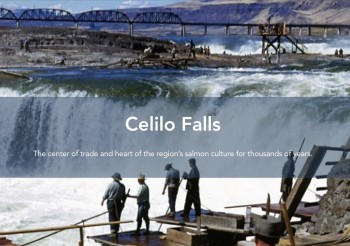
Celilo


By the early 1900s the Columbia River had been fished almost to extinction for salmon canneries. Salmon reproduce in freshwater tributaries, spend up to 8 years in the Pacific Ocean, and travel back upriver to their ancestral homelands. Big hydropower was added to the main stem Columbia starting in 1932. In 1941 the Grand Coulee Dam completely blocked salmon migration from 40% of the basin. In 1951 the Director of the U.S. Fish and Wildlife Service claimed that endangered salmon populations would benefit from a dam at the lower Columbia’s Celilo Falls. He claimed fish ladders would be easier for salmon to ascend than the rapids, and that by forcing Native fisherpeople off the river more salmon would travel upstream to reproduce.


In 1957, The Dalles Dam flooded Celilo Falls and the longest continuously inhabited villages in North America.

Responsive Video Example
Celilo

Image: CRITFC

From Judge Boldt to Judge Simon


Salmon populations did not increase with the flooding of Celilo. The electricity produced fueled America’s Cold War military buildup and the war in Southeast Asia (see our Where Is Don Sahong page). In 1974, Federal Judge G.H. Boldt ruled that Native fishers rights, guaranteed in 1855 Treaties with the U.S. Government, entitled them to 50% of the harvestable fish.


Native people had long argued that dams, chemical farming, logging, and other settler impacts had reduced fish populations, not Native fishers. The Columbia River Inter-Tribal Fish Commission was established in 1977 to provide coordination and technical assistance to the tribes in regional to international efforts to ensure that treaty rights and fisheries are restored and continue into perpetuity.


As much as USD 10 billion was spent on improved dam technology and operations, habitat restoration, fish breeding, and other salmon recovery tactics between the 1970s and 2020s. Salmon populations hover around 10% of their pre-colonial numbers, with wild salmon (not from hatcheries) making up a smaller percentage.


Some blame “ocean conditions,” overfishing, or the return of marine predators to the lower Columbia. In 2016, Federal Judge M. Simon ruled that a whole systems approach to prevent salmon extinction means dam removal must also be considered. Judge Simon’s decision renewed debate about the four lower Snake River tributary dams. Native organizing for salmon recovery and defense of Treaty Rights contributed to agreements like the 2023 Columbia Basin Restoration Initiative which established and all-of-government and whole-systems approach. And advocacy through media collaborations may have influenced public opinion.

Responsive Video Example

Pushpum and The Silent Green War


Thai journalists at Lanner News refer to “The Silent Green War,” the impact of the rush to decarbonize without changing high levels of  consumption by some, or examining the impact on others. The mining that is polluting Mekong tributaries (see the Mekong School page) sends rare earth minerals for wind and water turbines, and electrical grid components to the Columbia River basin.


Columbia River people warned that salmon depend on acting and thinking of the entire basin and humans as one system. A rapid change in carbon emissions is necessary. But they are questioning the impact they foresee in the current rush for green energy and data centers.


In May, 2026, One River Project stood on the ridge called Pushpum, translated as mother of roots. Native people, neighbors, officials, and the media gathered under wind turbines above the John Day dam, and overlooking a polluted former aluminum refinery on the shore of the Columbia River. They listened to river people discuss the value of the land, river, and its people, and relationships built over more than 10,000 years. They shared local food, music, song, and ceremony to remind themselves. The ‘green’ energy project proposed for the ridge is not necessary, and will not benefit local land, people, plants, or animals.

Responsive Video Example

Columbia River people have experienced impacts from mega-projects, mining, and other pollution. They have developed strong organizations and strategies to share. The speed of change, and the cultural and political differences in the Mekong basin have created different ways of non-violent organizing and action. Big river people of both basins benefit from sharing their experiences.