
Peace Walk For Rivers
Thailand shares a border with Myanmar. Civil war has allowed unregulated mining for valuable rare earth minerals to spread in border regions – polluting tributaries to major rivers in both countries. This is an international issue in Southeast Asia, and a global issue with mining regulation.
When this type of rapid change happens, within a few years, youth move away to cities to look for work. Seasonal festivals and ceremonies that bind communities together are also lost. On the main stem Mekong, some villages have not seen a birth in 10 years because all the young people left when the fishery collapsed.
For people downstream from these mines, everything they eat, drink, do, are, and have been for generations is at risk of ending. Respect for their equal humanity and knowledge requires understanding and respect for their relationship with with their river.
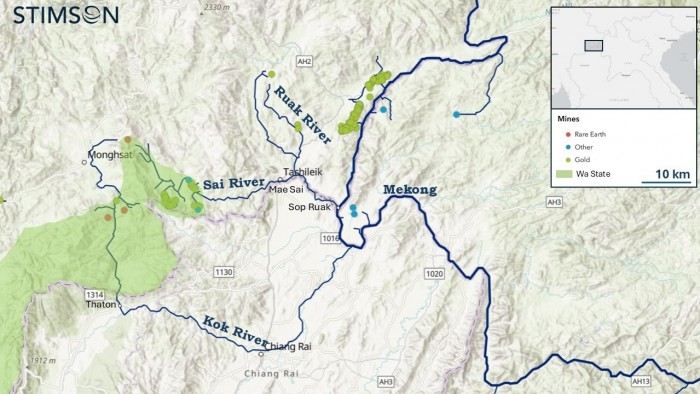
Image: Stimson Center
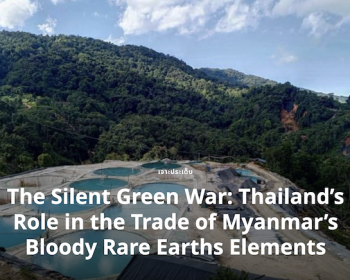
Photo and article link: Lanner News, Thailand
Peace Walk For Rivers
From Visakha Bucha Day on 31 May to World Environment Day on 5 June, 2026, the Abbot of Phawana Nimitra Temple led more than 50 novices, and allies of the People’s Network to Protect the Kok, Sai, Ruak, and Mekong Rivers on a series of Dhamma Yatras along the Kok River. The walks began in Tha Ton Subdistrict near the Myanmar border in northern Chiang Mai Province.
“Dhamma Yatra is not a parade, nor is it a protest. It is a peaceful, mindful walk. Dhamma Yatra means “walking with Dhamma.” But before we can walk with Dhamma — that is, walk with mindfulness, walk with goodwill towards nature and the people around us — we must first walk for the sake of Dhamma. And Dhamma in this context primarily refers to Nature.”
Along the Kok River, fertile flood plains, farms, and aquifers are being rapidly polluted with arsenic and other heavy metals. Some villages cannot sell or eat their produce or fish. They cannot drink their water. Sometimes the pollution is so severe they get rashes and open wounds from swimming or bathing in the river. Hundreds of people walked to draw international attention, and in solidarity with Kok River people and their river.
Visakha Bucha Day commemorates three monumental events in the life of the Buddha: his birth, enlightenment, and passing into Nirvana.
The Peace Walk covered 70 kilometers. Hundreds of people stopped twice per day to hear testimony from villagers, share questions, and organize future action. Villagers, monks, allies, and international media ate together. People shared information all along the route.
The Peace Walk followed the Kok River downstream to Chiang Rai City. Artists and musicians joined school children, ethnic minority groups, and workers on a walk to the Provincial Hall on the shore of the Kok River.
Hundreds of villagers, ethnic minority representatives, and allies gathered at the provincial hall for a meeting with provincial and national officials. They called for immediate support for the needs of river people: health care, clean water for drinking and household use, and action on lost livelihoods. And they called for international action on mining and supply chain regulation to protect current and future generations.
Columbia River people have experienced impacts from mega-projects, mining, and other pollution. They have developed strong organizations and strategies to share. The speed of change, and the cultural and political differences in the Mekong basin have created different ways of non-violent organizing and action. Big river people of both basins benefit from sharing their experiences.
The making of today’s Dhamma Yatra:
The Abbott “Rompo” had a meaningful plan.
The plan charted a route from Tha Ton to Chiang Rai.
Aiming to make society remember “Dhamma Yatra,”
The plan brought the voices of the people along the river basin, who were hurt by the toxic effects of mining, to the forefront.
It conveyed stories from the communities to the public, letting them know that the Kok River basin was waiting.
Hundreds of people, academics, and networks joined together with unwavering faith.
Transforming suffering into strength, even if it meant waiting.
We didn’t give up, even if it meant walking thousands of kilometers.
Let the “Dhamma Yatra” be a force.
Igniting hope on both sides of the river for progress.